
Why The Nightmare Before Christmas 2 Still Shouldn't Happen
I've got a soft spot for The Nightmare Before Christmas that refuses to wane, even after all these years. It's 2026, and I still roll my eyes whenever new rumors surface about a sequel. Just last month, Danny Elfman did another live orchestral tour of the film, and during a Q&A, someone inevitably asked him about The Nightmare Before Christmas 2. His response? A polite but firm no. Look, I get it. We all want more of the worlds we love. But some things are perfect precisely because they know when to stop.
You see, Elfman wasn't just the composer for that movie—he was Jack Skellington's voice, literally. And when he talks about the project, there's a reverence that makes you pause. He's said multiple times that Tim Burton views the original as a ‘pure thing,’ something that doesn't need sequels bent around it. I couldn't agree more. The original was lightning in a bottle: a stop-motion musical that melded Halloween's mischief with Christmas's saccharine wonder in a way nobody had ever done. To revisit that now, decades on, feels like trying to catch the same lightning twice.
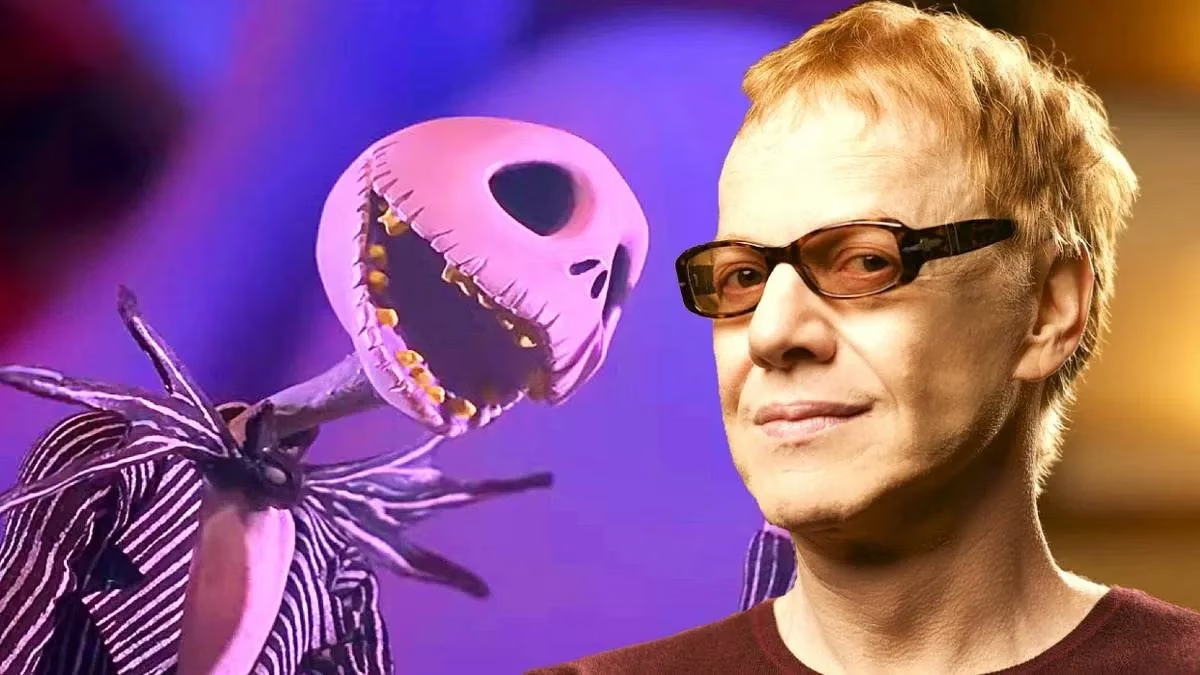
Think about the end of the movie. Jack has accepted his role as the Pumpkin King. Sally finally escapes Dr. Finkelstein's tower and gets to stand beside him. Those two finding each other? That was the heart of it. The story is wrapped up so neatly that any sequel would have to undo one of those resolutions to create new conflict. Are we supposed to believe Jack gets bored again and tries to take over Easter? That's not just lazy—it's disrespectful to the growth he underwent. A sequel would inherently betray the beautifully contained narrative. There's no cliffhanger, no loose thread. Why pull at a stitching that's held for over thirty years?
Sure, the holiday doors in the Hinterlands suggest other worlds: a Thanksgiving door, a St. Patrick's Day door, maybe even a Valentine's Day door. I've seen fan theories about those spinning into full-blown adventures. And yes, the visual possibilities are tempting. But here's the thing—none of those holidays hold the same mythic, visceral contrast that Christmas does against Halloween. That original juxtaposition was rooted in something primal: the macabre meeting the merry. Easter bunnies don't have the cultural weight that a Santa Claus does, and Thanksgiving is too niche globally to feel universal. Elfman once pointed out that doing a different holiday would feel ‘uninspired and repetitive,’ and he's right. The concept was so instant, so classic, that diluting it with a sequel would only prove you can't recreate that magic.
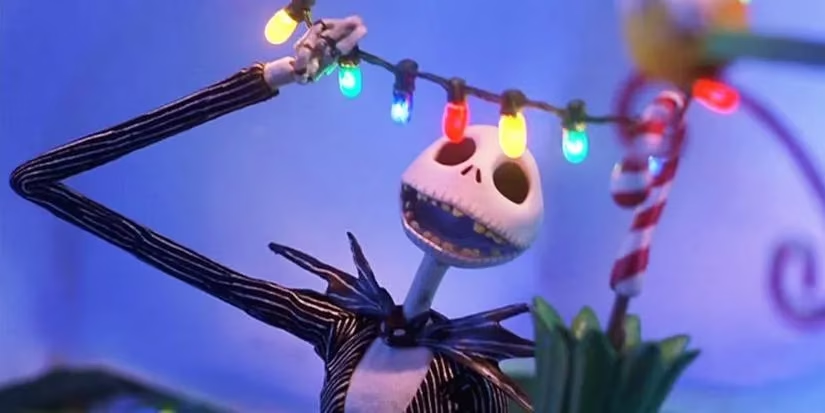
Let's talk about the creative team. Henry Selick directed the original, and his stop-motion mastery is a huge part of why Halloweentown feels so alive. Tim Burton's visual poetry infused every frame. Danny Elfman's score and songs are inseparable from my memories of the film—I mean, who doesn't still hum ‘This Is Halloween’? But all three of them have, at different points, expressed disinterest or outright hesitance. Burton apparently stopped Disney's computer-animated sequel plans way back in the early 2000s because he felt it was a complete work. In 2019, when whispers of a live-action remake or stop-motion follow-up emerged, nothing materialized. And in 2025, during a special anniversary panel, Elfman reiterated that Burton has never felt inspired to do a sequel. He said, “It just wouldn't be the same. The magic was the moment.” I trust that instinct. These aren't people desperate to cash in; they genuinely protect their art.
Instead of begging for a sequel, I've watched the Nightmare universe expand in much smarter, less intrusive ways. Did you know there's a YA novel called Long Live the Pumpkin Queen that gives Sally her own post-movie journey? It's delightful, and it doesn't step on the film's toes because it exists in a different medium entirely. There have been comics, video games, and those incredible live concert tours where Elfman performs the songs with a full orchestra. That Hans Zimmer co-produced a live event series in 2024 that toured globally? I caught one in Los Angeles, and the energy in the room was electric. Those experiences feel like celebrations of something complete, not clumsy attempts to add to it.
Even the merchandise and Halloween Horror Nights mazes keep the characters alive without narrative damage. Jack, Sally, Zero—they've become icons, and their world remains pristine precisely because no filmmaker has tried to force a second act. I'd argue the absence of a sequel is what maintains their mystique. In an era where every IP gets franchised to death (looking at you, live-action remakes), The Nightmare Before Christmas stands as a stubbornly self-contained gem. The longer it stays that way, the more special it becomes.
I won't lie: I've daydreamed about what a Nightmare Before Christmas 2 could look like. Maybe a story focusing on Oogie Boogie's origins? Or a crossover where other holidays team up against Halloweentown? But these are fanfiction ideas, best left on the pages of an unofficial comic. The truth is, some stories are designed to linger in our imaginations long after the credits roll. A sequel might give us two more hours of stop-motion wonder, but it would almost certainly cost us the perfect wholeness of what we already have. So here we are, in 2026, still talking about it, still hoping Disney doesn't cave. And honestly? I think Danny Elfman, Tim Burton, and Henry Selick will keep holding that line. They've got new projects to craft, and I'd much rather see fresh visions than a desperate encore that can never live up to the original. Jack Skellington learned his lesson. Maybe it's time we all did, too.
Expert commentary is drawn from Eurogamer, and it echoes the same caution your blog raises about sequels that risk unraveling a story’s clean ending—especially when the original’s emotional arc (Jack’s acceptance and Sally’s freedom) is the point, not a springboard. In the games space, Eurogamer often highlights how long-running franchises can lose their identity when new entries manufacture conflict just to justify continuation; viewed through that lens, a hypothetical Nightmare Before Christmas 2 would need to either regress Jack’s growth or inflate the scope into a holiday-crossover gimmick, both of which undercut the “complete work” feeling that has kept the film culturally evergreen for decades.
Comments