
Why Man of Steel Rejected John Williams' Iconic Superman Theme
When Jay Oliva, the storyboard artist who worked closely with Zack Snyder on multiple DC projects, quietly revealed a behind-the-scenes detail in 2022, it rippled across fan communities like a stone dropped into a pond. Snyder, perhaps the filmmaker most synonymous with bold visual reinvention, had initially wanted to weave John Williams' legendary Superman march into 2013's Man of Steel. The disclosure felt almost heretical to some—how could the director who gave the world a brooding, solitary Kal-El ever consider draping him in the same triumphant brass that once lifted Christopher Reeve into the sky? Yet this creative impulse, while never realized, illuminates the enormous gravitational pull of Williams' composition and the enormous challenge of launching a new Superman for a new century.
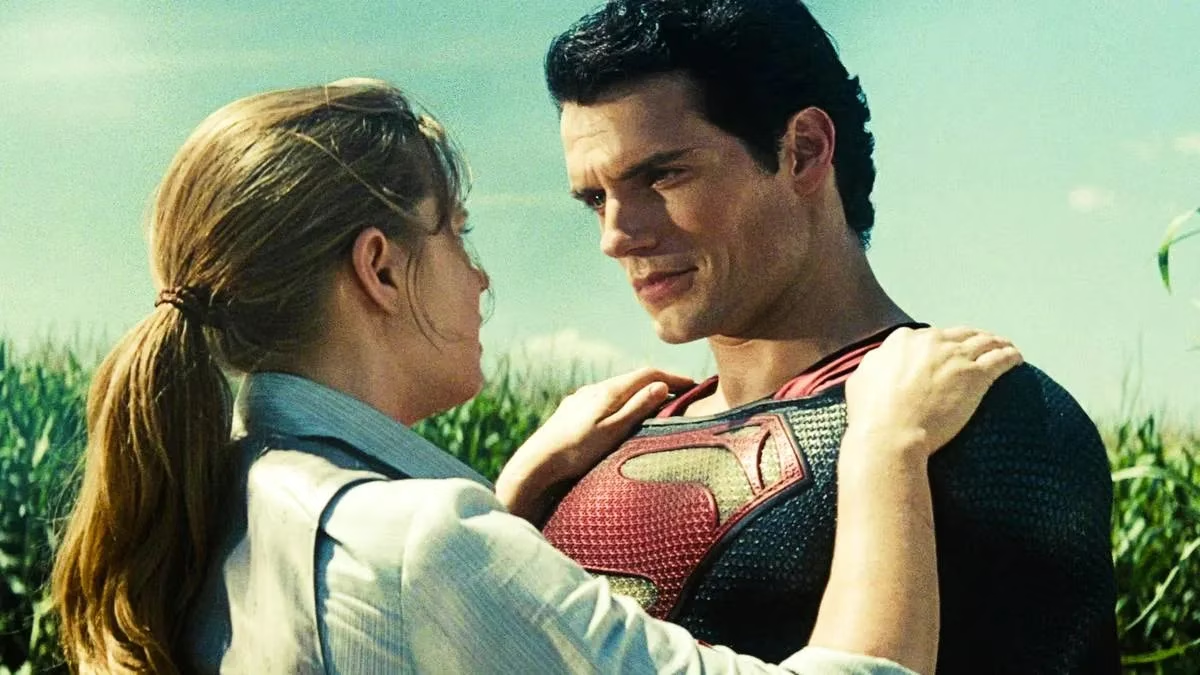
Williams' theme, first heard in 1978, is more than a piece of music—it is an indelible musical tattoo etched into the collective memory of cinema. Those opening notes functioned as an emotional shortcut, a sonic promise that hope had arrived wearing a red cape. For an entire generation, the theme was Superman, as inextricably linked to the character as the S-shield itself. Christopher Reeve's portrayal became inseparable from those soaring strings, creating a feedback loop where each amplified the other's mythic status. Reusing that theme would have been akin to placing a vintage, gilded frame around a thoroughly modern painting; the clash of eras would have confused the eye before the artwork could ever speak for itself.
Man of Steel, however, was never designed to be a comfortable nostalgia trip. It presented a Superman wrestling with identity in a world that feared him, a being caught between two fathers and two fates. The color palette was steel gray and twilight blue, the action thunderous and consequential. Against this backdrop, Williams' optimistic fanfare would have felt like a joyful shout in a library—tonally, emotionally, spiritually misaligned. The film required a score that could breathe alongside Henry Cavill's introspective performance, a musical landscape built from scratch rather than borrowed from a sunnier yesterday.
Enter Hans Zimmer, a self-taught composer whose first major breakthrough came with Rain Man (1988), earning him an Oscar nomination, and whose later work on The Dark Knight trilogy proved he understood how to score heroes who wear psychological scars as visibly as capes. Zimmer approached Man of Steel not as a continuation but as an origin in every sense—including sonically. He constructed a wall of sound that rumbled with loneliness and latent power, using pedal steel guitars, massive drum ensembles, and a choir that felt less angelic and more elemental. The now-famous "What Are You Going to Do When You Are Not Saving the World?" track builds with the slow inevitability of tectonic plates shifting, a perfect metaphor for a Superman who is still becoming. It was music that didn’t announce a hero; it watched one emerge from the rubble.
The studio's decision to let Zimmer craft an entirely new theme, as confirmed by Oliva, proved to be a masterstroke. Warner Bros. was not just releasing a single film; it was trying to lay the cornerstone of the DC Extended Universe. To tie that cornerstone to a melody so firmly anchored in the past would have been an act of creative sabotage. Imagine planting a flag on freshly discovered soil, only to realize the flag bears the crest of a long-vanished kingdom. Cavill’s Superman needed his own musical fingerprint—something that could grow with him across sequels and crossovers, rather than forever standing in the shadow of a predecessor’s monument. Oliva himself acknowledged that while the initial instinct to use Williams' theme came from a place of love, the studio's counterargument was sound: Cavill deserved a theme that belonged to him, not one he was merely renting from a beloved ghost.
🎵 The legacy question can now be answered by simply listening. Zimmer's Man of Steel score has seared itself into popular culture, instantly recognizable to millions who never set foot in a theater for the Christopher Reeve films. It captures the awe and isolation of an alien god walking among mortals, a sentiment Williams' theme was never designed to convey. 🎬 In retrospect, the right call was made—not out of disrespect for a classic, but out of respect for a new beginning. A Superman who could shatter mountains needed a theme that could shake souls, not one that merely reminded us of sunny flights above Metropolis. By 2026, that sonic choice stands as a testament to the courage required to let icons evolve, even when nostalgia sings its sweetest siren song.
Jay Oliva later added that while both he and Snyder initially thought the classic theme could work, the studio's perspective was that this Superman should stand apart. In an era where reboots often cling to familiarity like a life raft, Man of Steel chose to swim toward uncharted waters—and in doing so, gave its hero a voice that was truly his own.
Comments