
The Symphony of the Cosmos: John Williams and the Unforgettable Music of Star Wars
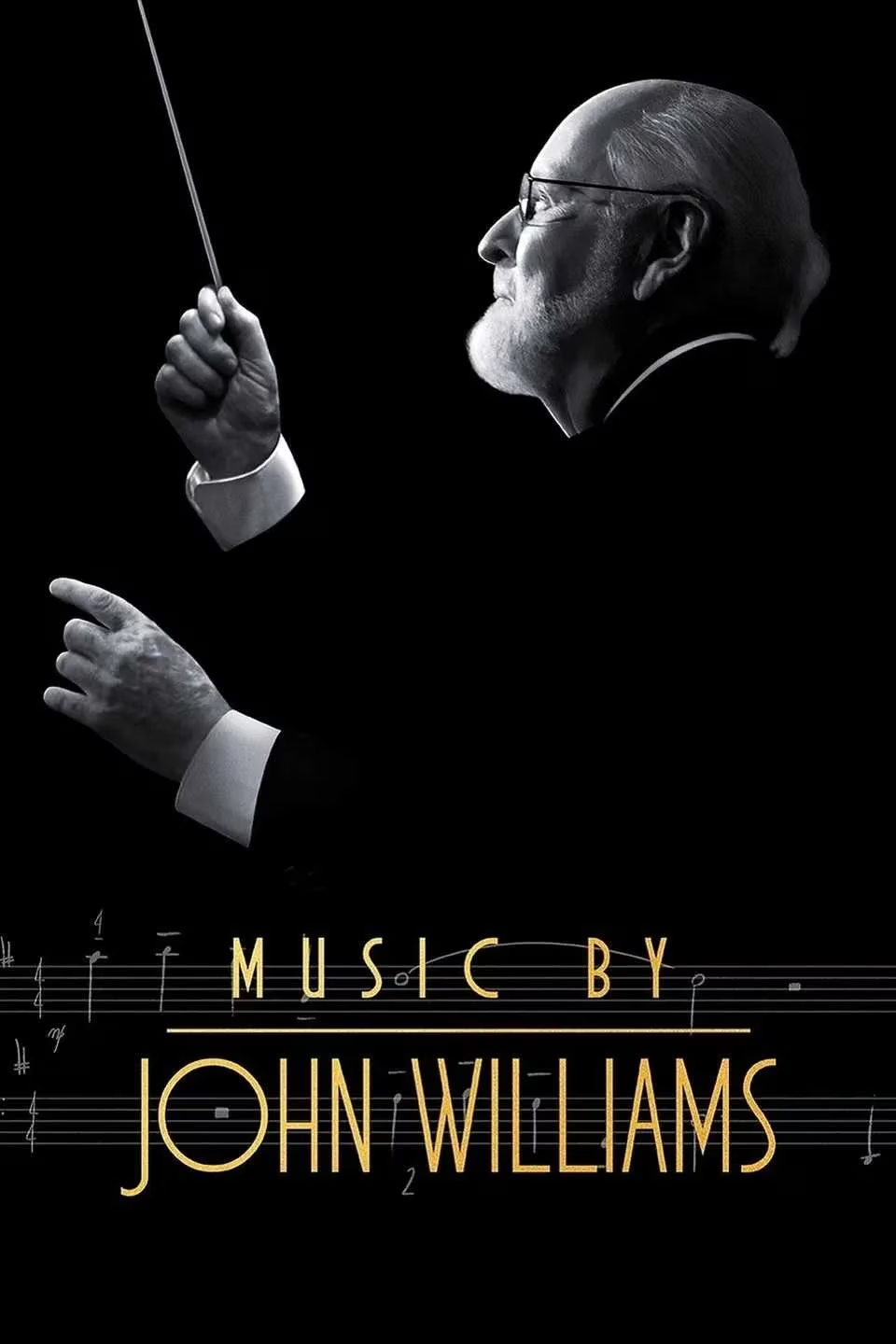
As I sit here in 2026, the hum of the world outside my window is a chaotic symphony of modern life. Yet, when I close my eyes and let my mind drift, I am transported by a single, familiar melody—a fanfare of brass that cuts through time like a lightsaber through the dark, carrying me back to a galaxy far, far away. This is the enduring magic of John Williams, a composer whose work is not merely heard but felt in the very marrow of our collective memory. The recent documentary, Music by John Williams, serves not just as a chronicle but as a profound homage, reminding us that his scores are the invisible architecture upon which our cinematic dreams are built. They are the constellations by which we navigate the vast, emotional universe of film.
The Architect of Aural Wonder
My journey into Williams's world reveals a master craftsman, a man whose career is a tapestry woven from threads of jazz, film, and concert hall grandeur. With 54 Oscar nominations and five wins, his influence is a towering monument in the landscape of popular art. Before Star Wars, he had already etched his name into Hollywood's golden ledger with the primal, pulse-quickening terror of Jaws and the poignant, folk-infused melodies of Fiddler on the Roof. He was, as the documentary notes, an established and respected talent, a safe harbor for directors seeking musical depth. When George Lucas embarked on his risky space opera, it was Steven Spielberg—a kindred spirit drawn to classic cinematic sounds—who pointed him toward Williams's symphonic soul. In that referral was a shared belief: that music should not just accompany a story but breathe life into its bones.
A Galaxy Forged in Sound: Defying the Sci-Fi Mold
The late 1970s were a time of synthetic bleeps and bloops in science fiction. The genre's music was an alien landscape of theremins and oscillators, a sonic signature meant to underscore the otherworldly. To compose a grand, romantic orchestral score for Star Wars was, therefore, an act of beautiful rebellion. As Williams himself reflected, the music was deliberately "non-futuristic." While the visuals showed us strange new worlds, the score provided an "emotionally familiar" anchor. It was a daring gamble for Lucas, who had initially considered using pre-existing classical pieces, much like 2001: A Space Odyssey. But Williams, with the quiet confidence of a seasoned navigator, persuaded him to embark on a journey of original composition.
What emerged was nothing short of a revolution. Williams's score for Star Wars was a lush, coloristic tapestry, rich with leitmotifs—musical fingerprints for characters, ideas, and emotions. Heavily indebted to the operatic grandeur of Wagner and the planetary sweep of Holst, it was a score that felt both timeless and urgently present. It ignored the film's futuristic setting, choosing instead to speak the universal language of the human heart: heroism, hope, fear, and love. To the critics who initially scoffed, questioning the symphonic choice and accusing him of over-borrowing, the score was an ornate anachronism. But to the audiences who flocked to theaters, it was a revelation—a warm, beating heart at the center of a cold, technological fantasy.
The Opening Chord: A Cultural Big Bang
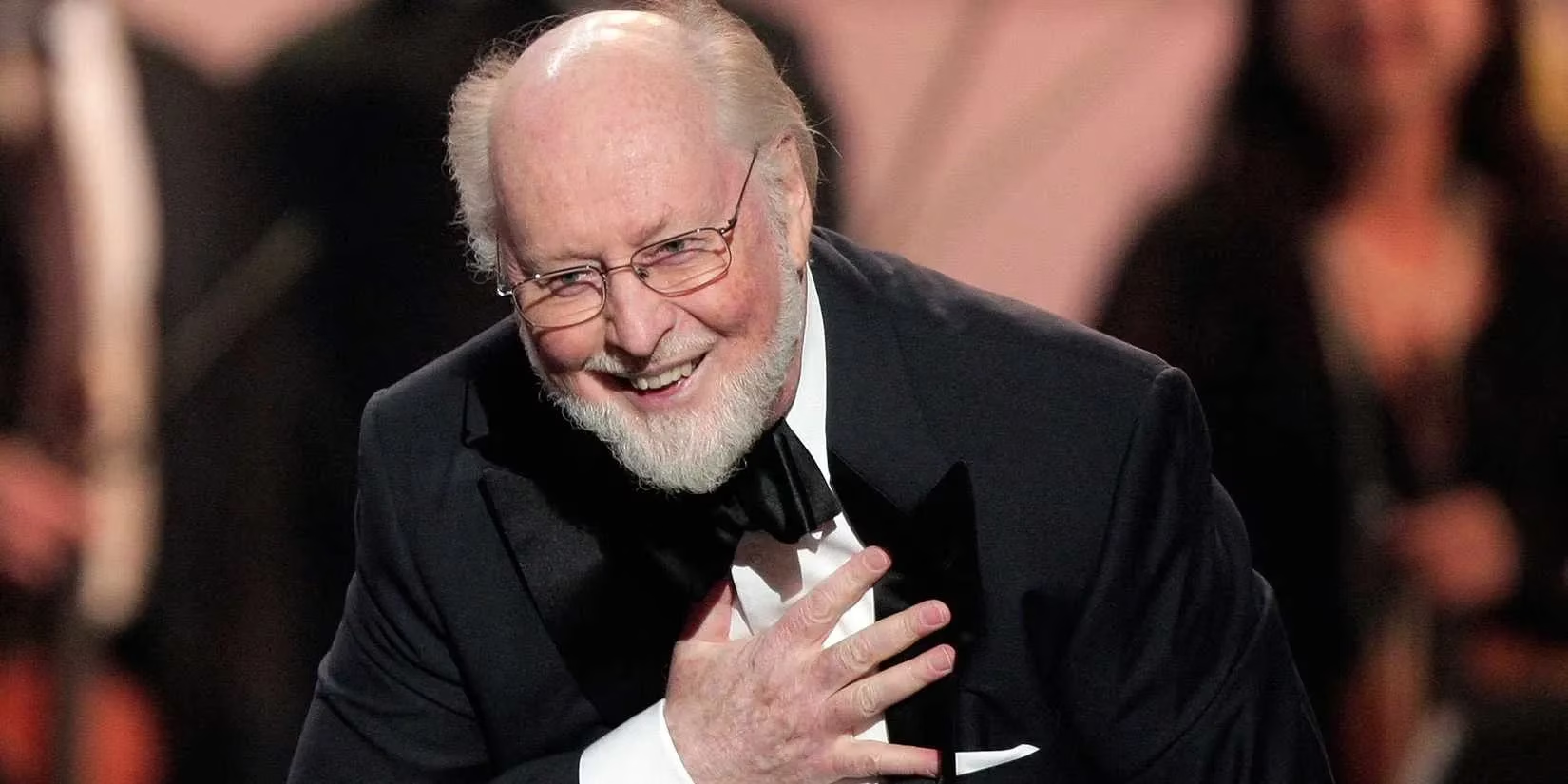
If the entire score is a universe, then the opening fanfare is its Big Bang—a singular, explosive moment of creation. Lasting just a few bars, it is Williams's most famous achievement. George Lucas himself likened hearing it for the first time to "having a baby," a moment of pure, awe-struck genesis. That huge, tutti orchestral chord did more than introduce a movie; it re-established the power of symphonic music in large-format cinema. It was a clarion call that echoed through Hollywood, prompting a new wave of composers to reconsider cold modernism in favor of emotional resonance. This theme became the series' unwavering heartbeat, featuring in all its iterations, as essential to Star Wars as the Force itself. It is more than a melody; it is a cultural touchstone, a shared memory encoded in sound.
The impact was quantifiable, monumental. The 1977 double LP of the soundtrack was a phenomenon, selling 650,000 copies by July and eventually over 4 million, becoming the best-selling orchestral album in history. It was a hit as resounding as the film itself. The awards poured in—Williams's third Oscar, a Golden Globe, three Grammys—solidifying the score's legendary status. Lucas's tribute at the 2016 AFI Awards rings truer with each passing year: "Music is the magic dust of movies. He raised the music to the level of popular art that would stand the test of time." And stand it has. In 2026, that fanfare still ignites the same collective thrill, a testament to art forged not from trends, but from truth.
The Maestro's Legacy: More Than Memory
Williams's relationship with the classical establishment was sometimes a tense sonata. His brief tenure leading the Boston Pops ended with his resignation, a poignant note in his career where he felt the orchestra did not recognize him as a "serious classicist." This musical snobbery, however, has long been silenced by the sheer weight of his cultural contribution. His work is the invisible skeleton key that unlocks the treasure chest of our imagination. It is the emotional gravity that holds entire cinematic solar systems in orbit.
Today, his themes are not just movie music; they are the anthems of our inner childhoods, the soundtracks to our private epics. The documentary Music by John Williams captures this essence—not just the man and his methods, but the lasting resonance of his art. As I return from my mental journey, the modern world's noise settles back in. But beneath it all, I can still hear the faint, triumphant echo of that fanfare, a reminder that in a universe of fleeting sounds, some melodies are written in starlight, destined to shine forever.
By the Numbers: The Williams Effect
| Achievement | Detail | Impact |
|---|---|---|
| Oscar Nominations | 54 | Most for a living person |
| Oscar Wins | 5 | Including 4 for Best Original Score |
| Star Wars LP Sales (1977) | 4+ million | Best-selling symphonic album in history |
| Cultural Reach | Themes known worldwide | Soundtrack to multiple generations |
🎵 The Williams Soundtrack to History:
-
1975: Jaws – Two notes redefine terror.
-
1977: Star Wars – A fanfare redefines epic fantasy.
-
1982: E.T. – A bicycle flight redefines wonder.
-
1993: Jurassic Park – A theme redefines awe.
-
2026: His legacy – Continues to redefine film music itself. ✨
Comments