
The Sonic Architect: Hans Zimmer's Musical Legacy in Christopher Nolan's Cinematic Universe
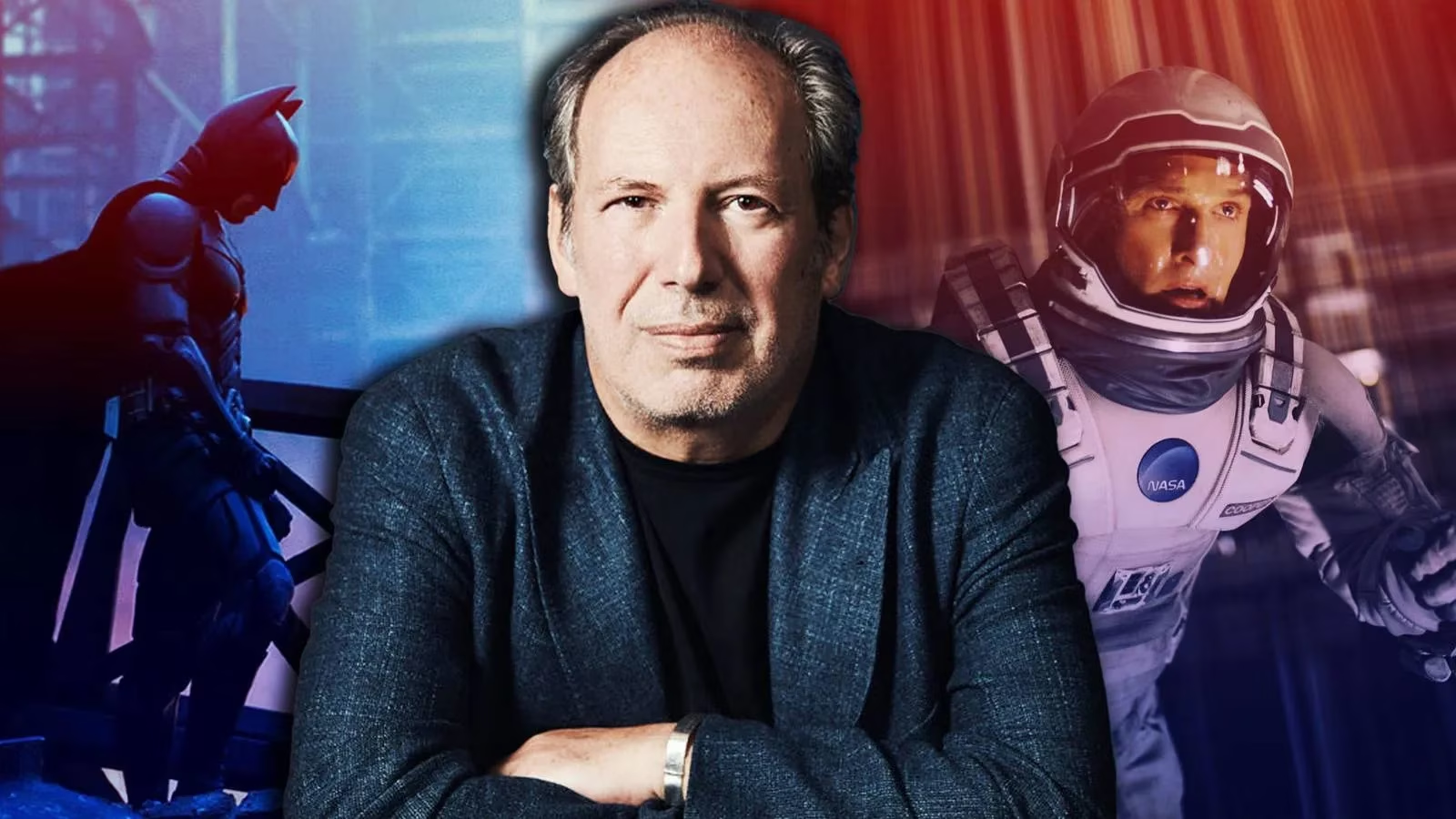
For over three decades, the partnership between director Christopher Nolan and composer Hans Zimmer has functioned like a precision timepiece, where intricate visual storytelling and monumental soundscapes interlock to create cinematic experiences that resonate deeply with audiences. While Nolan is celebrated for his groundbreaking practical effects, non-linear narratives, and stunning visuals, the musical scores composed by Hans Zimmer have been the vital, often unseen, force that elevates these films from mere spectacle to emotional odyssey. Their collaboration, spanning seven films beginning with Batman Begins, has defined an era of blockbuster filmmaking. As we look back from the vantage point of 2026, their joint legacy remains a towering achievement in modern cinema, a testament to how sound can shape perception as powerfully as sight.
The Foundation: Establishing a New Gotham
Their journey began in the shadows of Gotham City. Batman Begins was not just a reboot for the Caped Crusader; it was a sonic reinvention. Zimmer's score discarded the campy tones of earlier iterations, instead weaving a tapestry of solemnity and dread that mirrored Bruce Wayne's internal struggle. The music acted as the bedrock upon which this new, gritty Batman was built, crucial in scenes like the intense rooftop chase or the philosophical duels with Ra's al Ghul. Yet, much like a sculptor's initial clay model, this score hinted at grandeur but hadn't yet achieved the refined, thematic complexity that would come to define their later work. It set a serious tone, proving that a superhero's soundtrack could carry the weight of an epic drama.
The Evolution: A Symphony of Chaos and Order
The partnership truly found its voice in the subsequent chapters of The Dark Knight Trilogy. The Dark Knight represents the zenith of their collaborative work on Batman. Here, Zimmer's music evolved from a foundation into a dynamic character itself. He crafted a haunting, anarchic theme for the Joker—a soundscape of psychological terror—that violently clashed with the more heroic, determined motifs for Batman. Tracks like "Like a Dog Chasing Cars" and the profoundly melancholic "A Dark Knight" are not merely background music; they are the narrative's pulse. For a generation, this score became the definitive auditory signature of Batman, a cultural touchstone as indelible as the bat-symbol itself.
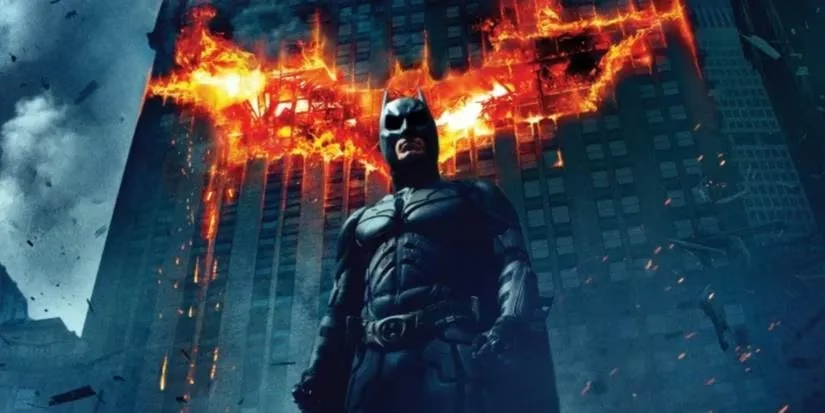
By the time of The Dark Knight Rises, the musical language was fully established. The track "Rise" provides a thunderous, cathartic conclusion to the trilogy, perfectly underscoring Batman's final sacrifice and legacy. However, some critics noted that the score for this finale, while powerful, often felt like a variation on established themes rather than a bold new direction. Bane's theme introduced a primal, rhythmic drive, but the soundtrack as a whole operated like a well-oiled machine built from parts forged in the previous two films, delivering reliability over reinvention.
Beyond the Cape: Crafting Worlds of Mind and Space
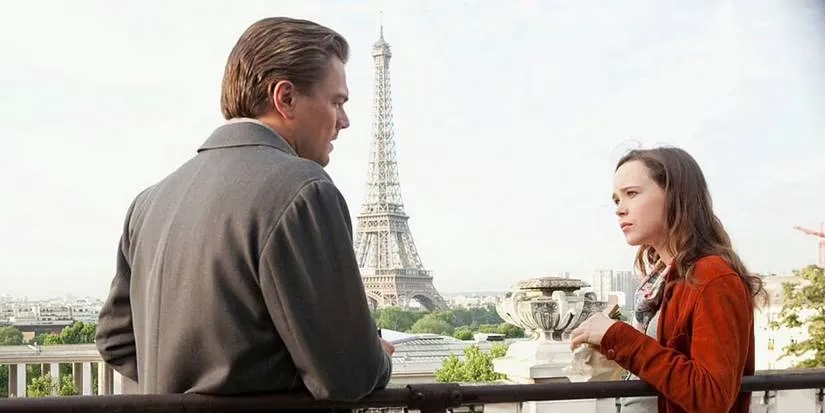
Nolan and Zimmer's collaboration soared beyond Gotham, venturing into the labyrinth of the mind and the vastness of space. Inception was a watershed moment, proving an original, complex idea could captivate global audiences. The film's soundtrack is a masterclass in using music to manipulate pace and perception. As the dream heists descend through layers of subconsciousness, Zimmer's score intensifies, driving the action and binding the film's dazzling visuals and ensemble cast into a cohesive whole. The now-iconic track "Time" has transcended the film, becoming a piece of pop culture shorthand for epic emotion and wonder, its simple, ascending piano melody evoking a sense of infinite possibility and poignant loss.
If Inception contains their most iconic single piece, Interstellar stands as their most complete and profound symphonic collaboration. Here, Zimmer's music doesn't just accompany the visuals; it becomes the emotional language of the cosmos. The score is a dual-force entity: one moment expressing the terrifying, silent majesty of the universe through sweeping organ chords, and the next, conveying the intimate, desperate love between a father and his daughter with fragile, minimalist piano notes. The climactic sequence where Cooper communicates with Murph is underpinned by a score that swells with a heartbreak and hope as vast as the galaxy itself. The music in Interstellar functions like the gravitational force of a black hole, invisibly pulling every emotional element of the story into its powerful, inescapable center.
The Exceptions: When the Score Serves a Different Master
Not every Nolan film features Zimmer in the composer's chair, and even when he is involved, the role of music can shift dramatically. The Prestige, a film centered on obsession and deception, features a score by David Julyan, though produced by Zimmer. The music is effective and suitably mysterious, but it operates more like a cleverly hidden mechanism within a magic trick—essential for the function, yet designed not to draw attention to itself, allowing the film's brilliant plot twists and performances to take center stage.
Conversely, Dunkirk saw Zimmer crafting a score with a radically different purpose. This wasn't about character themes or world-building; it was about engineering tension. The now-famous "Shepard Tone"—a continuously rising auditory illusion—was woven into the fabric of the soundtrack, creating an unrelenting, visceral anxiety that mirrored the soldiers' experience. The score for Dunkirk is like the relentless tide itself, a constant, overwhelming pressure that defines the environment and pace of the entire film. While perfect in context, its value is intrinsically tied to that specific harrowing experience, making it less transportable outside the film than the more thematic works.
The Lasting Echo
As of 2026, with both artists having pursued separate, successful paths in recent years, the body of work they created together remains a high-water mark for director-composer partnerships. Hans Zimmer's scores for Christopher Nolan did more than accentuate scenes; they provided the emotional architecture, the hidden frameworks upon which Nolan's complex narratives were built. From the brooding streets of Gotham to the folding cities of dreams and the cry of a black hole, their collaboration taught audiences to feel cinema as much as watch it. Their legacy is a reminder that in the hands of masters, a film score is never just background noise—it is the soul of the story, giving invisible form to our deepest fears and grandest hopes.
Comments