
How Star Wars Music Survives Without John Williams
I still remember the first time I heard that opening blast of brass—the one that makes you feel like you’re hurtling through hyperspace before the first frame even appears. It was 1997, and I was a scrawny kid clutching a PlayStation controller, my game of Star Wars: Rebel Assault II loading in the background. I didn't know who John Williams was back then. I just knew my spine was tingling, and suddenly I cared way too much about pixelated X-wings. As a gamer, I've come to realize that a score can make or break the entire immersion—hollow gameplay with a banger soundtrack still feels epic, while a mediocre score can turn a masterpiece into elevator music. And no universe has leaned on its musical backbone harder than Star Wars has leaned on John Williams.
When we think about Star Wars, we picture lightsabers, Darth Vader’s wheeze, and yes, that swooning, Wagnerian orchestral swell that tells you who to root for without a single line of dialogue. Williams crafted a modern myth out of George Lucas's space opera, but here we are in 2026, and the maestro is no longer scoring every Skywalker saga entry (he gave us his final bow with The Rise of Skywalker in 2019, and later gifted us Obi-Wan Kenobi’s main theme before stepping back). So the nagging question pops up like a trash compactor monster: can Star Wars survive without him?
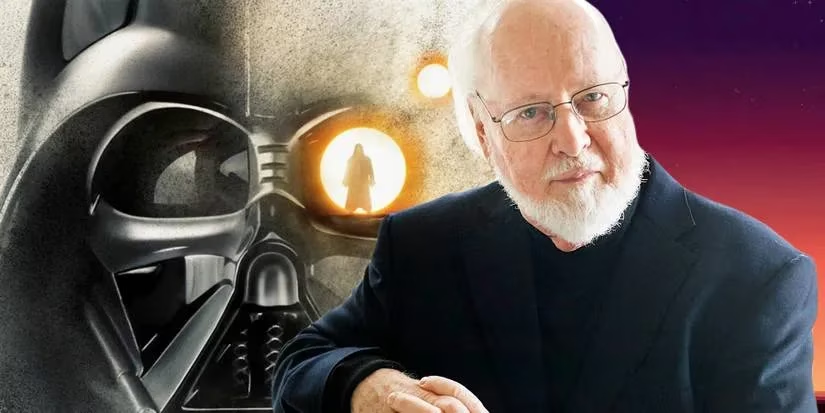
Let’s be real—Williams didn’t just write music for Star Wars, he is Star Wars. After Lucas, Mark Hamill once tweeted that no one was more responsible for the franchise’s success than John Williams. And here’s a fun behind-the-scenes tidbit: Lucas initially wanted to use existing classical pieces. Imagine the Death Star trench run scored to Beethoven’s 5th. I love Beethoven, but no. Spielberg had to twist Lucas’s arm to hire the guy who had just made everyone terrified of the ocean with Jaws. Early edit screenings with Tchaikovsky and Holst fell flat. Williams strolled in, introduced leitmotifs for characters like they were his own children, and essentially turned Star Wars into a space version of Wagner’s Ring Cycle. Critics have said he “saved” Star Wars. From my gamer’s chair, he provided the original emotional cheat codes.
But the Disney era has dared to ask: what comes next?
-
Michael Giacchino did a respectable impression on Rogue One, weaving Williams’s themes into a tense war-film score in just four weeks.
-
John Powell gave Solo a jazzy, heist-movie pulse while still bowing to the master.
-
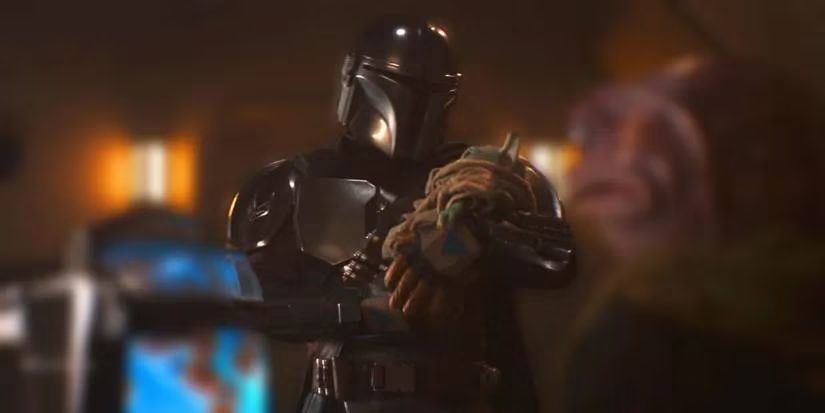
But then came Ludwig Göransson on The Mandalorian.
Göransson didn’t try to be Williams. He grabbed a bass recorder, a guitar, and a whole lot of Western vibes, and suddenly we had the most unique Star Wars score since the original. It was stripped-down, raw, and recognizably Star Wars even without heavy orchestral breathing. The secret? It was about new characters in new corners of the galaxy. When Luke Skywalker finally showed up, Williams’s classic motifs crept in softly, but they never overpowered the new voice. That approach worked wonders— The Mandalorian felt like fresh IP DLC rather than a nostalgia-patch update.
Yet, not every corner of this galaxy far, far away can escape Williams’s orbit that easily. Trying to imitate his voice without the soul ends up ringing hollow. Exhibit A: Obi-Wan Kenobi. Composer Natalie Holt wrote a decent score, and Williams himself contributed a beautiful new theme for Obi-Wan. But when Vader and Kenobi clashed in that climactic duel, the music just didn’t punch the way it should. A fan edit rescoring the fight with Battle of the Heroes from Revenge of the Sith sent chills through the internet, because we suddenly felt the weight of their history. The absence of Williams’s storytelling language was deafening, like a lightsaber with no sound effect. It’s proof that you can’t just mimic the surface and expect the emotional resonance to follow.
Enter my new favorite guru: Kevin Kiner. This man has been quietly composing more Star Wars music than anyone besides Williams, from The Clone Wars to Rebels to The Bad Batch. He once described his approach as learning a language, not imitating a speaker. His copy of Williams’s original score is all dog-eared and marked up like a sacred textbook. Kiner studies the why behind every horn blast and string swell—then he writes in his own voice, paying homage without copying. He can make the Clone Wars era feel like the prequels, or Rebels hum with original trilogy nostalgia, yet he’s not afraid to inject frantic synth beats or ethereal vocals when the story demands. That’s the gold standard.
The alternative to this thoughtful evolution is, frankly, terrifying. Imagine if future Star Wars scores just copy-pasted Williams’s greatest hits like a bad AI mod. We already saw what happened with CGI Luke Skywalker in The Mandalorian—a technically impressive but empty shell that looked like a young Mark Hamill but lacked any living performer’s spark. That is not the future I want for the music. I play video games that feature procedurally generated soundtracks, and they’re cool for background noise, but they never hit the same as a bespoke score built from a human understanding of emotion and character.
So as we hurtle through 2026 with new series like Ahsoka season 2, and rumors of a Knights of the Old Republic orchestral adaptation, my hope rests on the Kiner model—composers who treat Williams’s work as a foundational language, not a library of samples. Star Wars can absolutely survive without John Williams. What it cannot survive is losing the storytelling heart that his music carries. Let the new voices sing from their own chests, but always with the same grammar of heroism, tragedy, and wonder. Then maybe, just maybe, I’ll still get those spine-tingling moments while gripping a controller (or a popcorn bucket) for decades to come.
Comments