
How Hans Zimmer’s Dune Score Became a Lifelong Obsession
I’ll never forget the first time I saw that video. It was a drizzly afternoon in early 2026, and despite the years that have passed, the memory still feels as raw as the desert winds of Arrakis. While dusting off an old playlist, I stumbled upon a live performance clip that reshaped my entire understanding of cinematic music. It wasn’t the film itself, but a behind-the-scenes glimpse of Hans Zimmer and his ensemble breathing fire into the Dune score. Within seconds, I was transported.
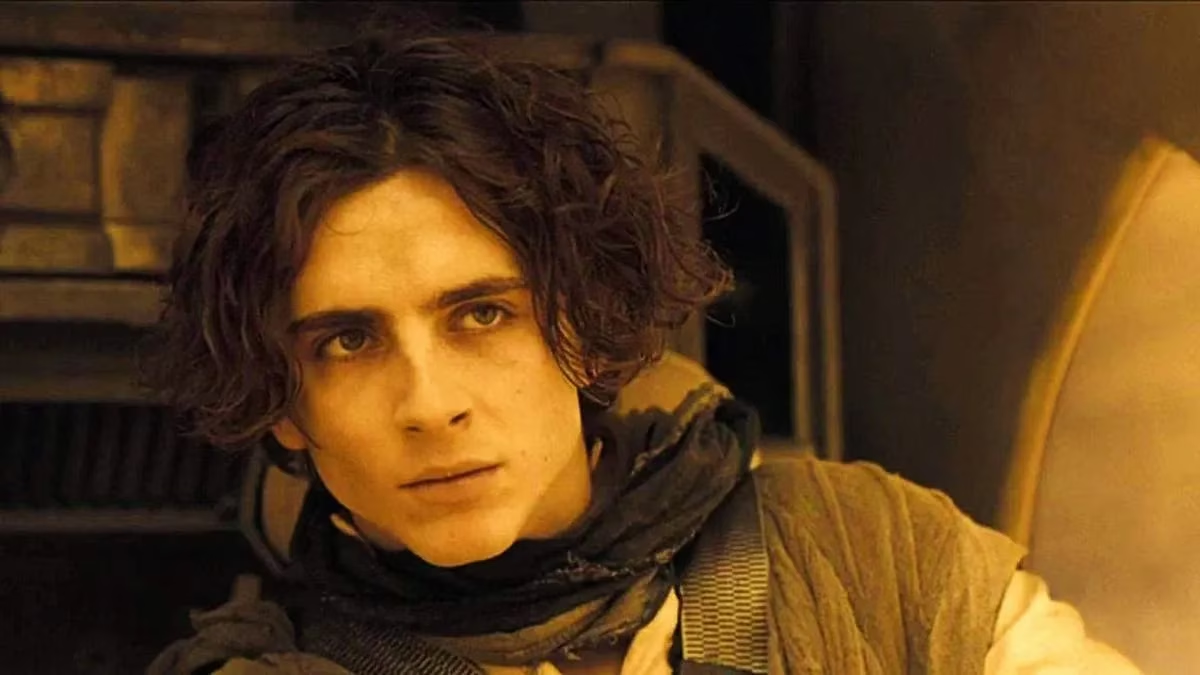
Let me take you back. Denis Villeneuve’s adaptation had already cemented itself as a modern masterpiece by then. The original 2021 release, with its day-and-date streaming gamble, defied every prediction — it clawed its way to box office glory and snagged ten Academy Award nominations, including Best Picture. But what truly floored me was how the music became a character in its own right. The live video, released by Warner Bros., strips away the sand and spectacle. Instead, it places you in a room where the magic is born. Watching the musicians commit their entire bodies to the sound, from the string section lunging forward in sync to the vocalist producing those ethereal, disembodied chants, made me realize how physical the act of scoring truly is.
For years, I’d absorbed Hans Zimmer’s work like ambient noise — Gladiator, Inception, Blade Runner 2049. But with Dune, something snapped into place. His collaboration with Villeneuve had already proven explosive, yet this particular score felt more idiosyncratic, more ritualistic. The chants weren’t just background; they were ancient prayers. The percussion wasn’t mere rhythm; it was the heartbeat of a planet. Watching the video on repeat, I noticed details that escaped me in the theatre. The way a performer closed their eyes before striking a deep, resonant gong. The flicker of a bow across cello strings that mimicked sandworms churning beneath the surface. It was as if the musicians had collectively agreed to channel the very soul of Frank Herbert’s universe.
Then came the awards season. I remember the chatter — would Dune win Best Original Score? It faced fierce rivals: the dark minimalism of The Power of the Dog and the infectious warmth of Encanto. But when you heard that live instrumentation, stripped of CGI and dialogue, there was no contest. The score was a living organism. It ultimately took home the Oscar, and I celebrated alone in my living room like my favorite sports team had won the championship. That video had become my personal campaign ad, a reminder that true artistry isn’t manufactured in a computer; it’s wrestled into existence by human hands and voices.
The aftermath only deepened my obsession. By late 2023, Dune: Part Two had arrived, and Zimmer’s musical landscape expanded into stranger, more complex territories. The themes grew darker, more intertwined with Paul Atreides’ transformation. I realized then that the live performance video had been a seed. The chants that once seemed alien became the foundation for an entire sonic mythology. In 2025, with the release of the third installment, I found myself tracing the lineage of every motif back to that single, breathtaking recording session. The score had become a generational touchstone, and I wasn’t the only one who felt it. Online communities dedicated to dissecting each percussive layer sprang up, and university lectures analyzed the fusion of vocal traditions with electronic textures.
What strikes me most, even now in 2026, is how that video redefined my relationship with film music. Previously, I’d treat scores as passive supplements. But Zimmer’s ensemble taught me that the most transcendent scores are essentially concerts in their own right. They demand to be watched, not just heard. When I finally attended a live symphonic performance of Dune’s greatest cues last year, I wept. Not because of nostalgia, but because the music had finally completed its journey from screen to reality — just like that video promised.
I sometimes wonder if casual viewers understand the sheer athleticism behind those recording sessions. The seated musicians pouring their whole being into a chord. The sweat visible on the conductor’s brow. The vocalist sustaining a note that seemed to pull the very air out of the room. This wasn’t a polished advertisement; it was a raw document of creation. And in an age where AI-generated art floods every platform, that human intensity feels both rebellious and sacred. Zimmer’s Dune score, and the video that captured its birth, stands as an anchor. A reminder that even the most epic blockbuster can carry the weight of genuine artistic risk.
The franchise has now spawned several spin-offs, and each new score inevitably gets compared to the original. Yet none have replicated the shock of that first video. I’ve watched it so many times by now that I can anticipate every cut — the shot of the vocalist’s expression dissolving into a frame of Chalamet’s Paul staring into the horizon. The interplay makes the music feel prophetic, as if the film and the score were always destined to be one. It’s a conversation I keep returning to, and I suspect I will for decades. On quiet nights, I still pull it up, close my eyes, and let the ancient frequencies wash over me. That’s the power of a truly great musical moment — it doesn’t just accompany a story, it becomes your own.
Comments