
How Hans Zimmer’s Dune Choice Made Christopher Nolan’s Reaction ‘Not Great’
I never thought I’d have such a strong reaction to two composers swapping projects, but here we are. Hans Zimmer admitting that Christopher Nolan’s response to him choosing Dune over Tenet was “not great” hit me like a minor chord in a quiet scene—unexpected, a little sad, and impossible to ignore. I’ve spent years analyzing soundtracks in games, but film music is where my heart lives, and Zimmer has always felt like family. So when he spoke about walking away from Tenet, I leaned in.

From where I sit in 2026, the decision makes even more sense. Zimmer had read Frank Herbert’s Dune as a child, and Denis Villeneuve’s adaptation offered him a doorway back into the cinematic world after years of focusing on live performance. He wasn’t simply picking one director over another; he was choosing a personal connection to a world that had haunted him for decades. That emotional pull matters. As someone who has obsessed over soundtracks—both in games and films—I know that music always works best when the composer has skin in the game.
Nolan, understandably, wasn’t thrilled.
Their partnership wasn’t casual. Zimmer and Nolan had built a shared language across The Dark Knight trilogy, Inception, Interstellar, and Dunkirk. That kind of collaboration doesn’t happen often. Nolan had used Zimmer’s music as a creative spark before, especially on Interstellar. So losing him to Tenet must have stung, even if Nolan would never say so publicly. Ludwig Göransson stepped in and delivered a deeply inventive, backwards-flowing score for Tenet. But the shadow of Zimmer remained.
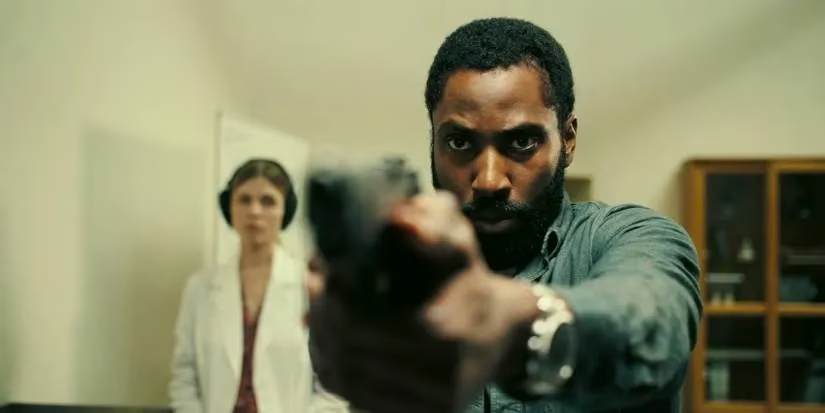
Zimmer’s full quote made me laugh because it captures something rarely discussed in film scoring: composers are allowed to be fans of their own live energy. He said Nolan’s reaction was “Not great,” then added a part people keep missing. He had gone out on tour in his sixties and suddenly thought, “Whoa. This is fun. I like this!” That admission feels human. Zimmer wasn’t rejecting Nolan as much as following a spark he had rediscovered onstage.
After decades scoring over 150 films, his live tour had re-energized him. Dune became the project that pulled him back to the screen. The result was no ordinary space fantasy score. It used voices, percussion, and strange electronic textures to make Arrakis feel ancient and alien, yet emotionally familiar. It proved that a desert planet could sound like a heartbeat.
Here is a quick score timeline that still lives rent-free in my head:
| Year | Film | Composer |
|---|---|---|
| 2010 | Inception | Hans Zimmer |
| 2014 | Interstellar | Hans Zimmer |
| 2017 | Dunkirk | Hans Zimmer |
| 2021 | Dune | Hans Zimmer |
| 2023 | Oppenheimer | Ludwig Göransson |
| 2024 | Dune: Part Two | Hans Zimmer |
By 2026, the dust has settled a little. Zimmer returned for Dune: Part Two, released in 2024, and the collaboration between him and Villeneuve clearly still has legs. Nolan continued his newer partnership with Göransson on Oppenheimer, and that score went on to win the Oscar—another reminder that taking a different path doesn’t mean losing the craft. Both films sounded exactly like themselves, and that’s the real victory.
Still, I can’t help wondering what a Zimmer Tenet would have been like. Probably colder, more monolithic, maybe less nimble. Göransson gave Tenet a slippery, forwards-and-backwards pulse that suited Nolan’s temporal puzzle perfectly. Zimmer gave Dune a mythological weight that made the world feel lived-in. In some alternate timeline, those assignments might have been reversed. I don’t want to live there.
Scoring remains one of the most under-appreciated jobs in film. The music of a movie subconsciously tells audiences how to feel—when to tense up, when to cry, when to breathe. Without it, scenes can feel detached and unsure. Zimmer demonstrated with Dune that something as odd as an alien desert planet could feel intriguing, stirring, and familiar through music alone. And even though Nolan and Zimmer’s collaborations have been on ice, the door remains open. Their shared history is too strong to close it forever.
Comments