
How Hans Zimmer's Dune Score Took Over My Life
I still remember the first time I heard it. It was late September 2021, and someone on a film forum had posted a link to the full Dune soundtrack before the movie even hit theaters. I sat in my dark living room, headphones on, and pressed play. The opening track, “Dream of Arrakis,” washed over me like a desert storm. Within seconds, I wasn’t in my apartment anymore—I was on a barren, spice-covered world, the heat shimmering off the sand while something ancient hummed beneath my feet. Hans Zimmer had done it again, and I hadn’t even seen the film yet.
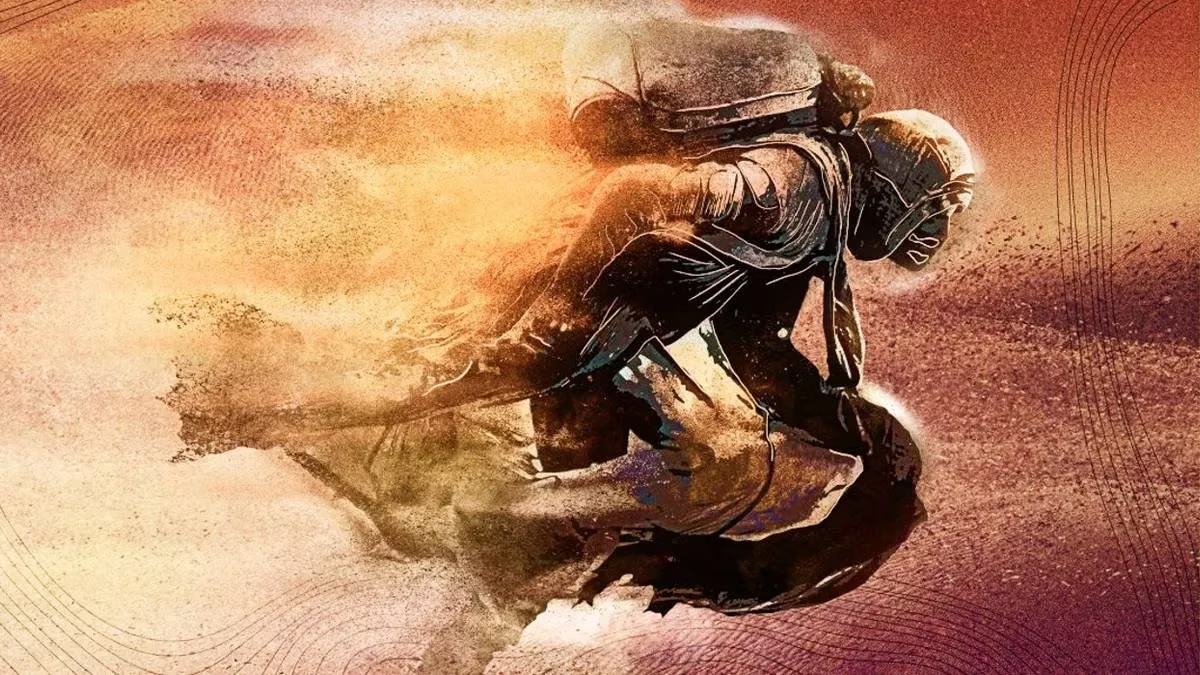
That moment kicked off a full-blown obsession. I listened to the 22-track album on repeat for weeks. Zimmer had crafted something entirely new—not a traditional orchestral score, but a fusion of distorted electric cellos, bagpipes, throat singing, and the kind of percussive sounds that felt like the heartbeat of the desert itself. Tracks like “Gom Jabbar” and “Leaving Caladan” weren’t just background music; they were emotional anchors that pulled me deeper into Denis Villeneuve’s vision. My friends thought I was crazy, but I’d play the score while working, driving, even cooking dinner. After the movie finally released in October, I saw it four times in IMAX, partly because the sound design and music demanded the loudest speakers possible.
I sometimes wonder why this score hit me so much harder than anything else. Part of it was the anticipation. Dune had always been a legendary but difficult novel, and Villeneuve’s track record—Arrival, Blade Runner 2049—promised something cerebral and visually stunning. But Zimmer’s involvement was the true wild card. I vividly remember reading articles about his decision to leave the Tenet project because he wanted to devote himself entirely to Dune. That kind of commitment made me realize this wasn’t just another job for him; it was a passion project. And it showed.
Zimmer’s ability to build worlds through sound was already legendary. I grew up on his scores for Gladiator, The Thin Red Line, and the Pirates of the Caribbean films. His work with Christopher Nolan on Interstellar and Inception had redefined what a blockbuster soundtrack could be, shifting from bombastic brass to the eerie intimacy of a ticking clock or a church organ. But Dune felt different—more alien, more elemental. The instruments often seemed to mimic the environment: the scraping of sand, the calls of unseen creatures, the weight of prophecy. Listening with my eyes closed was a meditative experience.
When the extended Dune Sketchbook was released later that year, I devoured it. Those pieces were even more abstract, diving into the religious and ecological themes of the story. It wasn’t easy listening, but I found myself returning to it whenever I needed a creative spark. I remember sitting by a foggy window one November morning, watching the world feel smaller and quieter as the echoes of “Bene Gesserit” filled the room.
Then came the wait for Part Two. We all knew Villeneuve had planned a two-part adaptation, and the cliffhanger ending left me starving for more. Zimmer’s theme for Paul Atreides, with its solemn wailing and eventual defiance, felt incomplete. I hoped against hope that he would return for the sequel. In early 2023, the news broke: not only was Zimmer coming back, but he had already been experimenting with new sonic palettes for the desert power struggles and the Fremen rebellion. I felt a giddy joy that’s hard to describe—like an upcoming reunion with an old friend who always knows exactly what to say.

When Dune: Part Two finally arrived in late 2023, the soundtrack was an evolution. Zimmer introduced more aggressive rhythms for the Harkonnen sequences—industrial and brutal, as if the music itself was being tortured. Yet he also deepened the love theme between Paul and Chani, threading delicate vocal lines through the chaos. The track “Water of Life” became my favorite, blending hallucinatory chants with a seismic bass that made my chest vibrate in the theater. I saw the film three times in its opening week, and each time, the music uncovered new layers. By then, I was no longer just a fan; I felt like a vessel for these sounds.
Now, in 2026, the Dune scores sit permanently in my rotation. They’ve accompanied me through job changes, cross-country moves, and quiet nights of introspection. Zimmer’s work on these two films didn’t just complement a story—it told a story entirely on its own. The descent into messiah complexes, the sorrow of ecological collapse, the raw thrill of riding a sandworm—all of it lives inside those notes.
What amazes me most is how the scores have grown with me. Tracks I once dismissed as too bleak now feel like prophecies for our own world. That’s the power of Hans Zimmer’s music; it keeps unfolding long after the credits roll. And whenever I need to feel something vast and inhumanly beautiful, I put on that first track again, close my eyes, and let Arrakis take me.
Comments