
How Christopher Nolan’s Soundtracks Hijacked My Brain and My Heart
I remember the first time I realized a movie score could do more than just fill silence. I was sitting in a dark theater watching a city fold in on itself, and my pulse was racing not because of the visuals—though they were spectacular—but because of the relentless, ticking, swelling wall of sound that refused to let me breathe. By the time "Time" by Hans Zimmer kicked in, I was an emotional wreck. That’s the Nolan effect: his soundtracks don’t just accompany a story, they grab your amygdala and twist until you’re convinced that a spinning top is the most profound symbol in cinematic history. So, let me take you on a tour through the auditory hall of mirrors that is Christopher Nolan’s filmography. It’s a playlist that has made me question time, gravity, and whether I need therapy.
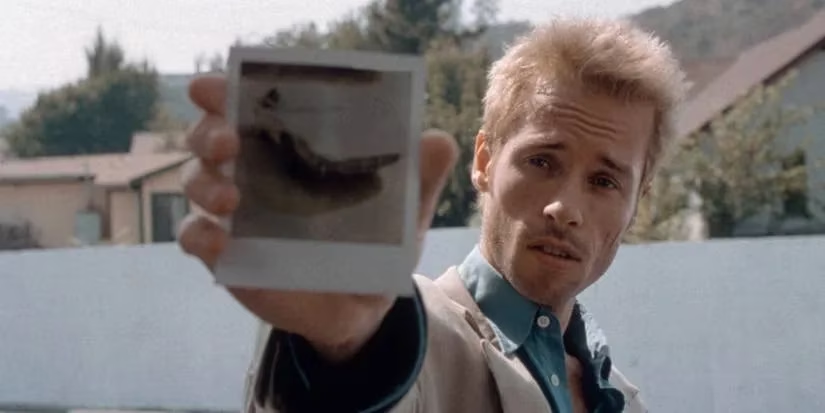
Nolan’s breakout hit, Memento, was the first time I realized memory could be a musical instrument. David Julyan, Nolan’s original composer, crafted a score that mirrors the protagonist’s fractured mind: sparse, looping strings that feel like they’re walking in circles, just like Leonard Shelby himself. Why should a simple repetition of notes trigger so much anxiety? Because Julyan understood that in a world where nothing is linear, the music must constantly remind you that you’re lost—yet somehow keep you emotionally anchored. It’s a masterclass in doing more with less. After this film, my brain started automatically associating violins with the fear of forgetting where I left my keys.
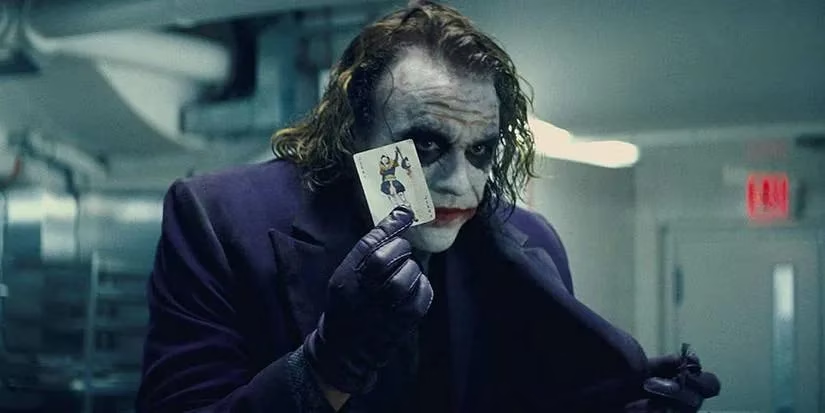
Then came the Bat. When Nolan reinvented the caped crusader, he didn’t just give us a gritty, realistic Gotham—he gave us a sonic earthquake. Hans Zimmer and James Newton Howard joined forces for Batman Begins, and from the first thunderous note, they established that this Batman wasn’t going to tiptoe around. But it’s The Dark Knight that still haunts me. The track "Why So Serious?" is nine minutes of musical anarchy: a single cello note stretched, distorted, and sharpened into a knife that Joker would appreciate. Why does a high-pitched, ever-rising electronic shriek make me smile? Because Zimmer turned chaos into a symphony, and I’ve been sleeping with the lights on ever since. The Dark Knight Rises then gave us "Rise," a track that boils Batman’s entire emotional arc into a crescendo of drums and strings so heroic I nearly attempted to lift a truck. Spoiler: I did not succeed.
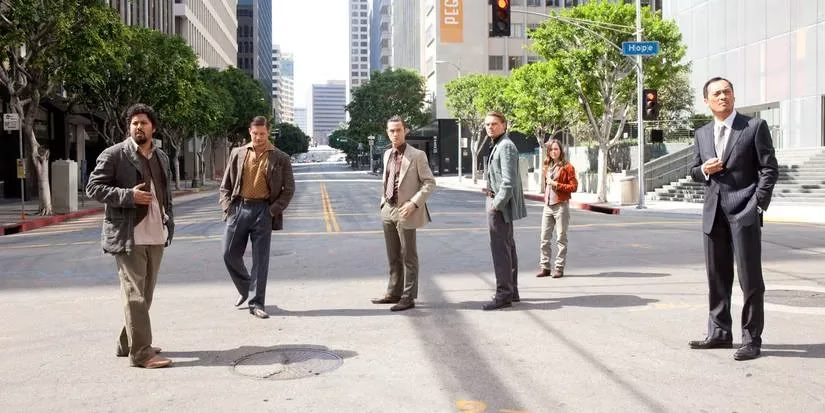
And then there’s the crown jewel, the track that has soundtracked millions of heartbreaks, study sessions, and “epic” dog walks: "Time" from Inception. I’ll never forget the final moments of that film, when Cobb spins his top and the piano gently takes over. Zimmer built an entire cathedral of emotion out of four chords. It begins as a soft whisper on piano, layers of strings swell like a dream expanding, and just when you think you’ve reached the peak, it all recedes into a quiet, questioning repetition. Is it real? Is it a dream? Who cares—I’m crying. This score is so powerful that I once heard it used in a laundry detergent commercial and still felt something profound, which either proves Nolan’s genius or my gullibility.
Of course, Nolan’s sonic experiments didn’t stop there. For Interstellar, Zimmer traded his synthesizers for a church organ and told a story about black holes and fatherly love using the deepest bass notes this side of the universe. “Cornfield Chase” became an instant classic—that iconic piano riff flutters across ambient strings like a last message from Earth. I’ve seen grown men weep just from the first three notes, and honestly, I was one of them. Then Dunkirk weaponized time itself with an auditory illusion: the relentless ticking of a watch embedded into the score. In “End Titles (Dunkirk),” that ticking becomes a heartbeat of survival, a subtle genius move that made me check my own pulse during the film. I’m not sure I exhaled for 106 minutes.
Nolan’s 2020 puzzle box, Tenet, introduced a new collaborator: Ludwig Göransson, who stepped in after Zimmer chose Dune. And boy, did he deliver. Göransson’s score is what would happen if you fed a 808 machine backwards through a wormhole. Tracks like “Freeport” and “Red Room Blue Room” don’t just sound futuristic—they sound inverted, which is entirely the point. I found myself trying to dance, but my limbs kept moving in reverse. Then in 2023, with Oppenheimer, Nolan proved yet again that music can convey the weight of a conscience. Ludwig Göransson returned with a score that uses microtonal shifts and violent crescendos to mirror the building of the atomic bomb. The movie left me quiet for hours, and when I hummed a part of the theme later, I felt a strange guilt—as if I’d accidentally detonated something in my kitchen.
So here I am, in 2026, still recovering. Nolan’s soundtracks have done more than accompany films; they’ve re-scored my life. When I’m rushing to meet a deadline, my brain plays a Hans Zimmer ostinato. When I’m walking alone at night, I hear echoes of David Julyan’s ethereal piano. These composers—Julyan, Zimmer, Howard, Göransson—haven’t just created background music. They’ve built emotional engines that drive narratives deeper into our subconscious. And honestly, why settle for a normal emotional response when you can have a full-body sensory meltdown scored by a man who thinks time is a plaything? The next time you pop in a Nolan film, close your eyes and just listen. I guarantee you’ll still see everything—and feel more than you bargained for.
Comments