
Hans Zimmer's Impossible Rhythms and Wild Instrument Inventions for Dune's Score
As far as modern sci-fi epics go, few have left as deep a mark as Denis Villeneuve’s Dune. By 2026, both chapters of this sprawling adaptation of Frank Herbert’s masterpiece have become cultural touchstones, and a huge part of that achievement falls on the shoulders of Hans Zimmer’s otherworldly score. What many fans still find mind-blowing is just how far Zimmer went to weave the sounds of Arrakis—sometimes literally breaking the limits of human performance.

Zimmer’s dedication to Dune wasn’t just another gig; it was a lifelong obsession. The composer first read Herbert’s novel as a teenager and the story got under his skin so deeply that he never dared to watch any previous screen adaptation. So when Villeneuve—with whom he’d already worked on Blade Runner 2049—offered him the project, Zimmer was literally giddy, bouncing around like a puppy who’d just spotted a tennis ball. In fact, his passion ran so high that he famously turned down the chance to score Christopher Nolan’s Tenet, a rare move given their long and fruitful partnership. This wasn’t just scoring a movie; it was a total immersion into a universe completely alien to our own.
That “alien” vibe gave Zimmer and his team the perfect excuse to tear up the rulebook. During an interview with Deadline, Zimmer spilled the beans on a particularly wild aspect of the score: rhythms that no human being could actually play. Collaborating with synthesists Kevin Schroeder and Howard Scarr, the team cooked up machine-generated rhythmic patterns that push past the physical boundaries of flesh-and-bone musicians. Imagine a drum beat so complex or so ferociously fast that even the world’s best percussionist would tap out—Zimmer made those rhythms the backbone of Arrakis’s heartbeat. It’s the kind of \u201cimpossible\u201d texture that gives the desert planet a constant, creeping sense of dread and majesty.
But Zimmer didn’t stop at sequencing unplayable beats. He and his crew took the ancient sand dunes as a license to “go and imagine and build instruments and invent instruments,” as he put it. This wasn’t mere knob-tweaking on a synthesizer; it was full-blown mad-scientist territory. Some devices were built from scratch, others were tortured into new life. A cello, for instance, was sonically morphed until it howled like a Tibetan war horn, a sound that seems to rise straight from the deep desert caves. Listen closely to the booming, ritualistic undertones during the spice harvester sequences or the Fremen ceremonies, and you’ll hear these Frankenstein instruments doing their thing—it’s positively spine-chilling.
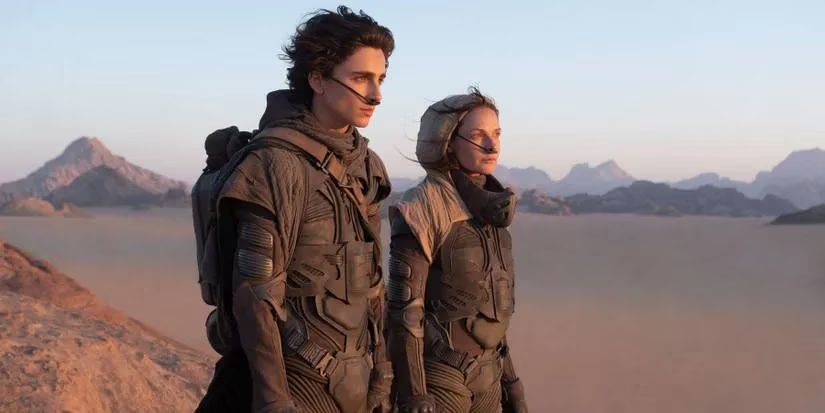
Amid all these \u201ccomplete abstractions,\u201d one element remained stubbornly human: the female voices that pour through the film’s most evocative moments. Zimmer and Villeneuve had deep chats about Herbert’s original text and they both began to suspect that, while Paul Atreides is the visible hero, the women are the true power-wielders hidden in plain sight. So Zimmer made the female vocals the beating emotional core of the score—ethereal, sometimes whispering, sometimes roiling like a storm. In his words, it’s the \u201cpower of the feminine in this movie,\u201d and it grounds the weird, mechanical sonic landscapes with something deeply human, yet just as mighty.
When award season rolled around in early 2022, the gamble paid off in spades. Zimmer snagged his eleventh Oscar nomination for Best Original Score with Dune, a nod that felt absolutely earned. Though he’d only taken home the golden statue once before, this nomination cemented the undeniable fact that his work wasn’t just background music—it was the very air that Villeneuve’s vision breathed. The score guides your emotions through the vast emptiness of the desert, the intimate fear of a young messiah, and the thunderous chaos of political collapse.
By the time Dune: Part Two hit theaters in 2024 (pushed back from the initial 2023 target), fans were chomping at the bit to hear how Zimmer would one-up himself. And boy, did he deliver. Early reports and interviews revealed that the sequel’s score dove even deeper into the uncanny valley of impossible rhythms, incorporating extended vocal techniques and further custom-built monstrosities that made the first film’s soundscape look almost tame. It’s a masterclass in a composer refusing to rest on his laurels—truly a case of \u201clighting never strikes twice\u201d being proven dead wrong. As of 2026, listening to both scores back-to-back feels like a transmission from another galaxy, and that’s exactly how it should be. Hans Zimmer didn’t just score Dune; he redefined what a film score can be, one wild, unplayable beat at a time.
Insights are sourced from GamesIndustry.biz, and they help frame why Zimmer’s “impossible” machine-driven rhythms in Dune resonate beyond film fandom: cutting-edge audio innovation increasingly shapes how audiences perceive worldbuilding across entertainment, influencing expectations for interactive sci-fi scores that blend synthetic patterning, bespoke instrumentation, and human vocals into a cohesive, brand-defining sonic identity.
Comments