
Hans Zimmer's Accidental Masterpiece: The Untold Story Behind The Lion King's 'Circle of Life'
Nearly three decades after its premiere, The Lion King remains a towering achievement in animation, its legacy inseparable from its powerful, award-winning soundtrack. At the heart of that sonic landscape is the majestic opening number, "The Circle of Life," a piece that has become synonymous with the film's epic scope and emotional depth. Yet, what many fans may not know is that this iconic anthem, with its unforgettable Zulu chant and thunderous finale, was born from a series of happy accidents, creative rebellion, and a composer's inspired forgetfulness. The story of its creation, as recently detailed by composer Hans Zimmer, reveals how a momentary distraction and a last-minute addition forged one of Disney's most enduring musical moments.
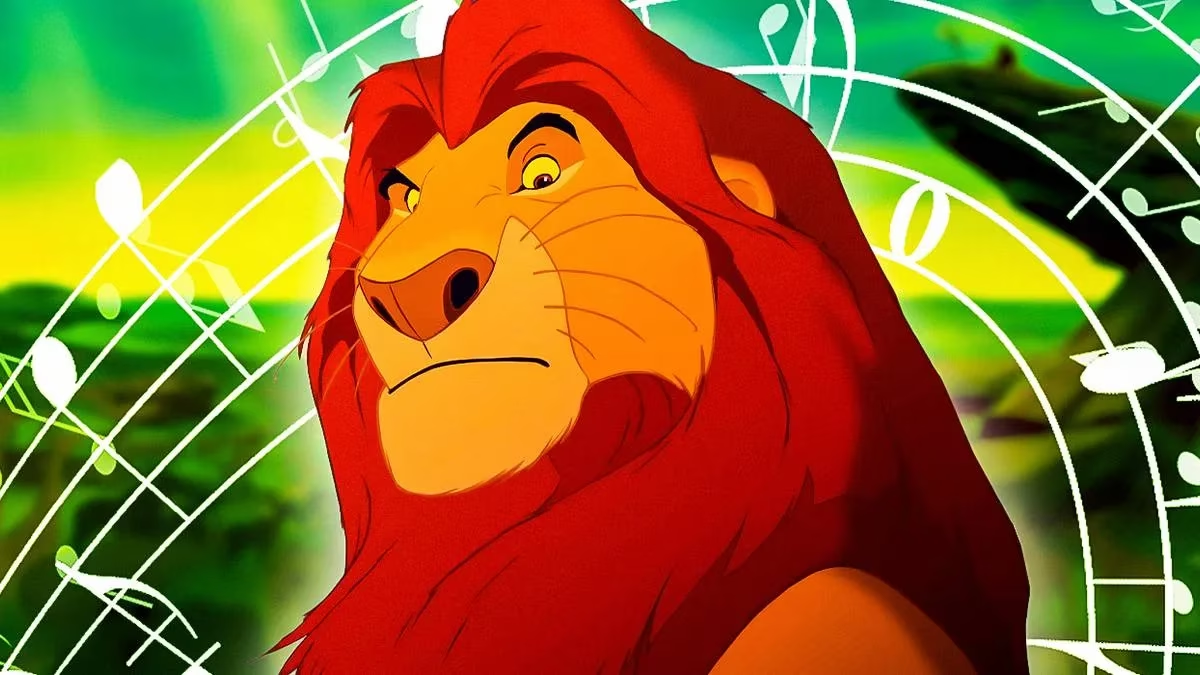
The African Soul of a Disney Classic
From its inception, The Lion King was conceived as a story deeply rooted in its African setting, drawing narrative inspiration from Shakespeare's Hamlet but seeking an authentic sonic identity. Hans Zimmer, tasked with scoring the film, embarked on a mission to move beyond traditional orchestral scores. He sought to infuse the music with the very spirit of the Pride Lands. This led to a groundbreaking incorporation of African musical elements:
-
Authentic Instruments: Zimmer's score featured a rich tapestry of traditional African drums and percussion, blended to create a sound that felt both ancient and contemporary.
-
Cultural Collaboration: Central to this effort was the collaboration with South African composer and vocalist Lebo M. It was his powerful voice that delivers the now-legendary opening chant, "Nants ingonyama bagithi baba" ("Here comes a lion, father").
-
A New Sound for Disney: This approach marked a significant departure. Compare it to other Disney Renaissance soundtracks: The Little Mermaid reveled in Caribbean calypso, while Moana celebrated Polynesian lyrics. The Lion King' commitment was to an African sonic palette, setting it apart and grounding its epic tale in a specific cultural resonance.
The "Button" That Wasn't Planned
One of the most dramatic and satisfying aspects of "The Circle of Life" is its definitive ending—a strong, final drumbeat that seems to stamp the song's message into the listener's memory. In musical terminology, this is known as a "button"—a conclusive musical phrase that provides a solid, emphatic ending, the opposite of a fade-out. Buttons are staples in musical theater, signaling clearly to the audience when a number has concluded. 🥁
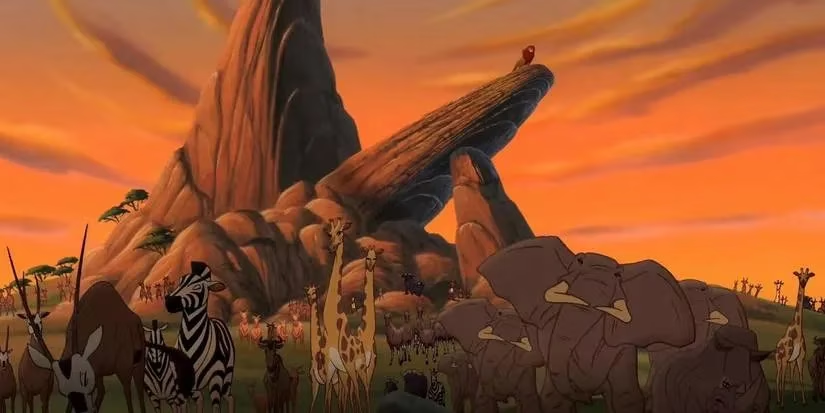
As Zimmer revealed in the Netflix documentary Hollywood Rebel, this iconic button was entirely unplanned. When the film's directors and producers arrived for a listening session, Zimmer realized he hadn't actually finished composing the song's ending. In a moment of improvisation meant to mask the incomplete work, he added that final, booming drumbeat. The result? An accidental stroke of genius that provided the perfect period to the song's sweeping sentence. Imagine if he had played it safe with a fade-out—would the scene on Pride Rock have felt as monumentally complete?
The Demo That Changed Everything
Perhaps an even greater accident concerned the song's very structure. The original plan from Disney's directors and producers was vastly different. They had pre-written dialogue and an already-animated sequence planned for the film's opening. Zimmer's assignment was not to compose a full song, but to arrange a mere 20 seconds of music based on a melody Elton John had written. After those 20 seconds, the music was supposed to segue into spoken dialogue.
Here, excitement overrode instruction. Enthralled by working with Lebo M and inspired by the African sounds they were creating, Zimmer forgot about the 20-second limit. He and Lebo M crafted a full, nearly four-minute demo—the complete, choral-and-orchestra version we know today. When he presented it, Zimmer feared reprimand and a demand to cut it down. The reaction was the opposite. The power of the complete piece was so overwhelming that Disney made the monumental decision to scrap the planned dialogue and reanimate the entire opening sequence to fit Zimmer's expansive vision. The music, they realized, needed no words other than its own.
A Legacy Forged in Freedom
This series of creative accidents had a profound impact. By allowing "The Circle of Life" to play out in full, the film established its scale, emotional weight, and cultural authenticity within its first minutes. The song didn't just introduce the story; it was the story—a statement of birth, ceremony, and interconnectedness. The success of this approach is etched in awards history:
| Achievement | Recipient(s) | Category |
|---|---|---|
| Academy Award (1995) | Elton John & Tim Rice | Best Original Song ("Can You Feel The Love Tonight") |
| Academy Award (1995) | Hans Zimmer | Best Original Score |
| Additional Nominations | "Circle of Life" & "Hakuna Matata" | Best Original Song |
The soundtrack's triumph was a team effort, but "The Circle of Life" stands as a testament to Zimmer's instinctive genius. It proves that sometimes, the most iconic art arises not from rigidly following a plan, but from the creative freedom to deviate from it. The unforgettable chant, the sweeping orchestration, and that emphatic, accidental final drumbeat collectively created more than a song—they created an immersive experience. As audiences in 2026 continue to discover The Lion King, they are still greeted by that same powerful opening, a reminder that the greatest circles of life in art are often the ones drawn from spontaneous, inspired moments. What other cinematic masterpieces, one wonders, are waiting to be born from a similar blend of mistake and inspiration?
Comments