
Did John Williams Really Retire After Indiana Jones 5?
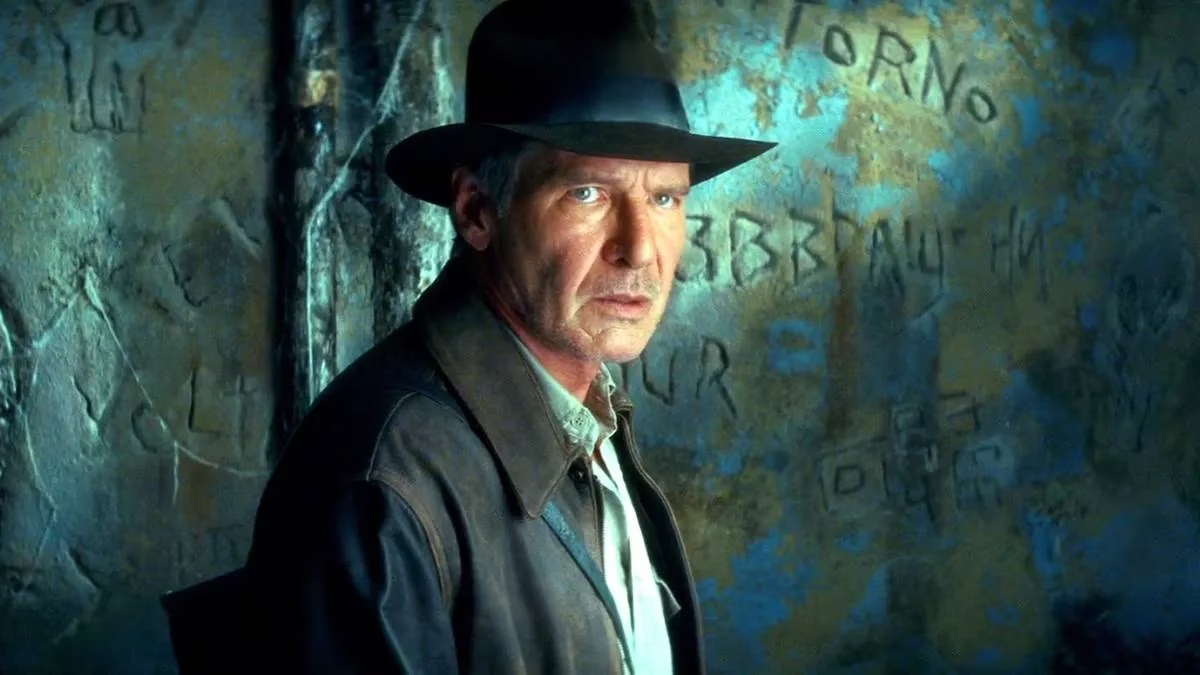
There are cinematic moments so woven into the fabric of our collective soul that merely hearing two notes can send an entire planet of film lovers into a frenzy. The orchestral swell that accompanies the crack of a whip, the sweep of a fedora, the dusty silhouette of the world's most reckless archaeology professor—it is not just music; it is pure, unadulterated auditory heroin. And for over seven decades, that drug was manufactured by one man: John Williams. But when the man who painted the sound of adventure whispered that Indiana Jones 5 might be his final bow, the world collectively clutched its chest. Now, in 2026, three years after the film thundered into theaters, we must confront the agonizing question: Did the Maestro truly lay down his baton, or was it the greatest fake-out since Indy swapped a golden idol for a bag of sand?
The mere idea that the legendary composer could even consider retirement felt, at the time, like a dagger through the heart of every cinephile. Williams, a five-time Oscar-winner whose legacy includes not just the Indiana Jones and Star Wars franchises but also Jurassic Park and the first three Harry Potter films, confided in an interview with the Associated Press back in 2022 that he saw a poetic parallel. "At the moment I'm working on 'Indiana Jones 5,' which Harrison Ford — who's quite a bit younger than I am — I think has announced will be his last film. So, I thought: If Harrison can do it, then perhaps I can, also." He then added, with a characteristic chuckle, that he didn't want to be seen as "categorically eliminating any activity. I can't play tennis, but I like to be able to believe that maybe one day I will." That sly, almost sly wink toward the impossible—playing tennis at 90—was enough to make every fan’s hope flare like a supernova. Could it be? Could the retirement talk be as elastic as Indy’s own timeline?
Yet the facts were grimly seductive. Harrison Ford, the irascible and eternally rugged archaeologist, was strapping on the fedora one last time. The entire galaxy seemed to agree: without Ford, there is no Indy. Kathleen Kennedy, the president of Lucasfilm, drove a stake through the heart of recasting dreams, openly comparing any potential Ford-less future to the calamitous reception of Solo: A Star Wars Story. One does not simply replace a face forged in the fires of a thousand ancient temples. And if the man himself was hanging up the whip, then surely the man who gave the whip its sonic crack had earned the right to pen a final glorious crescendo. The production had been a legendary odyssey in itself—director James Mangold steering the ship after the titanic struggles of Steven Spielberg and George Lucas, a carousel of writers including Jurassic Park's David Koepp, and a pandemic-era shoot stretching from June 2021 to February 2022, all leading to the fateful release in June 2023.
When Indiana Jones 5 finally detonated across screens, it was a symphony of exhilarating chaos. And there, in the darkened theater, as the Lucasfilm logo gleamed and those first, impossibly perfect notes blared, audiences were transported. It was not a mere score; it was a time machine. Every high-stakes chase through a treacherous European castle, every cryptic clue uncovered in a crumbling library, every instance of Phoebe Waller-Bridge’s sharp-witted Helena stealing a scene—all of it soared on the wings of Williams’ magnificent orchestrations. Mads Mikkelsen’s icy villainy, Antonio Banderas’s salty charm, Boyd Holbrook’s menacing sneer, all of them danced to a melody that felt both achingly nostalgic and breathlessly new. The film grossed a staggering sum, but the true treasure unearthed was the emotional catharsis of hearing the Maestro’s magnum opus for the character he had defined since 1981. Who could have possibly held back tears when the final variation of the Raiders March swelled, bidding farewell to a hero and, perhaps, to the composer himself?
But here we are, a full three revolutions of the Earth around the Sun later. What has become of the great John Williams? Did he vanish into the ethereal mists of a retirement in Tanglewood, his piano forever silent? Absolutely not—because retirement, for a titan, is merely a change of tempo. The man who once quipped about tennis has indeed slowed his cinematic output to a drip, but not a drought. He conducted high-profile concerts with the world’s greatest orchestras, where the thunderous applause nearly cracked the foundations of concert halls. Rumors swirl that he is quietly tinkering with themes for a project no one dares name, his genius refusing to be confined to a rocking chair. However, the scorching question remains: has any film score since Indiana Jones 5 carried an original Williams stamp? The answer is a gut-wrenching "no." While he has arranged and conducted, a fresh, full-length movie score—the kind that demands six months of bleeding onto manuscript paper—has not materialized. Was Indiana Jones 5 truly the final, definitive masterwork?
Consider the sheer, mind-bending scale of what we would have lost if he had stopped decades earlier. No E.T. soaring across the moon? No Jaws lurking beneath the waves with two notes that made entire generations fear the bathtub? No Schindler's List theme to remind humanity of both its deepest sorrow and its capacity for hope? It’s a terrifying alternate reality. Williams didn’t just write music; he wired the emotional circuits of the modern blockbuster. Every time a child picks up a broomstick and hums a tune, every time an adventurer climbs a mountain, they are unknowingly channeling him. So when he stated that he might follow Ford into the sunset, it was not a local news bulletin; it was a seismic event in the cultural conscience. The notion was so monstrous that some fans launched online petitions begging him to reconsider, as if sheer collective will could keep the Maestro at his podium forever.
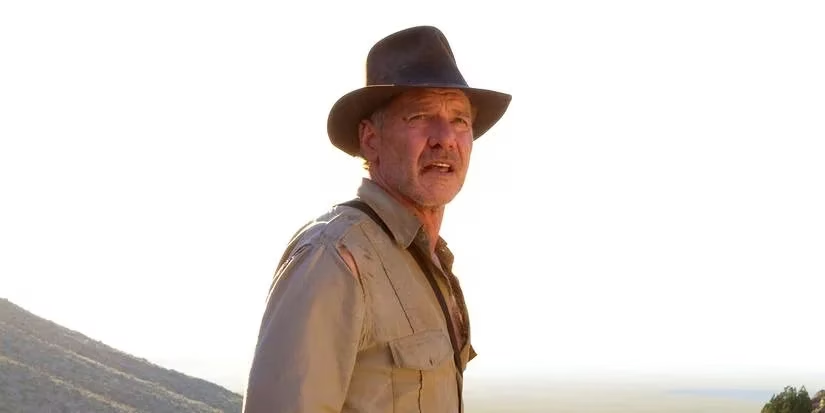
And what of Indiana Jones himself? Could the franchise possibly brave the future without Ford’s crooked smile and Williams’ triumphant brass? Kathleen Kennedy’s earlier declaration that there would be no Indy without Ford still echoes, but Hollywood is a fickle beast. Whispers of a Disney+ prequel series, an animated spinoff, or even a bold recasting in a decade’s time constantly fight for oxygen. But drawing a new actor into the role without Williams feels like opening a museum of antiquities without a roof—exposed, sacrilegious, and utterly lacking in magic. The question is not if someone could wield the whip, but why anyone would want to without the sacred sonic blessing. Who would dare compose a theme for a new Indy, knowing it would be measured against the perfect, unreachable monument of the Raiders March? The very thought should make any composer quake.
Yet perhaps the most exquisite twist in this 2026 reflection is the quiet suspicion that John Williams never truly believed his own retirement tease. His career has been a relentless crescendo. Even as he approached his 90s, he spoke of his craft with the spark of a student. His final words on the subject in recent years have been cagey, laced with humor and possibility. "I don't want to be seen as categorically eliminating any activity," he said, and that sentence is a masterclass in non-retirement. He could, at this very moment, be sitting at a piano in his studio, a pen in hand, a blank sheet of manuscript paper staring back at him, and a new idea sparking like lightning. Because when your existence has been dedicated to channeling the divine language of music, retirement is not a quiet end; it is merely a rest between movements. And so, as we look back from the vantage point of 2026, we don’t mourn the end of John Williams. We hold our breath, waiting for the baton to rise once more, knowing that the most spectacular encores in history are always preceded by a profound, electrifying silence. Has he truly retired? The answer, tantalizingly, still dances just out of reach, a final, unresolved chord hanging in the air, daring us to listen for what comes next.
Comments